Showing posts with label Northwoods. Show all posts
Showing posts with label Northwoods. Show all posts
Thursday, 10 September 2015
Sassafras Northwoods
Begun another paddle today in the backyard "workshop". This one is from a thick board of Sassafras. A paddle in the collection of the Hudson Museum in Maine (see original post ) was the inspiration. It featured a segmented grip with graceful curves and a stretched out beavertail blade.

Hudson Museum Paddles (Credit: Bob Holtzman)
My version was shortened to 58" long and the blade design was the large Passamaquoddy blade used before on this paddle and its twin here. Sassafras is so flexible and lightweight this design has potential to be my go-to tripping blade. Unfortunately, the only Sassafras I could source out was a thick 8/4 thick board, which meant a lot of chopping was needed to thin the blade down to size. This turned out to be a slow process...mostly because of the heat in the city and the inviting Muskoka lounge chair set up in the shade. Think I spent too much time relaxing with a coffee and got distracted enjoying a fantastic Cuban robusto cigar (Partagas Series D4). Eventually the blade got thinned down enough to start using the spokeshave and in the next couple of days I'll start finishing off the rest.


...Continue to Part 2 Update HERE

Friday, 9 August 2013
Fixing an old failure scarfing a grip onto a sassafras northwoods Part 2
When working on the old busted sassafras tripper, a scarf repair was attempted on the shaft so that the paddle could be salvaged into a user again.

A joint was cut and a sassafras cutoff was successfully glued up.

A new centre line was drawn on the upper portion and a squarish grip similar to a design at the Maine Hudson Museum was sketched out. After cutting out the profile, the grip was worked on vigorously with a crooked knife and rasp to get the desired "grip bumps" and angled edges.

The new grip
The blade had weathered after being exposed untreated to the elements for years. It had been positioned upside down in the garden along the east fence line. The back of the blade facing the yard hard had weathered to a light brown colour while the more exposed face weathered into a greyish black patina.


Different sides of the weathered blade
After the successful glue repair, the shoulder and shaft area of the original blade revealed that the underlying sassafras has turned its golden brown. Between the blade weathering, the darkened sassafras and the light creamy new sassafras grip, the paddle now has 3 distinct colour tones. Not sure at this stage if I'll leave the paddle as is or attempt to lightly stain the new sassafras to at least darken it a bit.
March 25, 2017 Update: Paddle shaft has been wrapped with leather and is now complete. See the final post HERE.
Thursday, 23 June 2011
Walnut Passamaquoddy Northwoods Grip
After my modest success with the Cherry Maliseet and Fusion Paddle, I next decided to tackle another intriguing design. Graham Warren refers to this as the Passamaquoddy style...a narrow ottertail shaped blade and an elongated grip with carved stations for a variety of gripping positions. Upon doing some more searches, I come across some photos on Doug Ingram's Red River Canoe site outlining this grip in Cherry and Black Walnut. Another description was found on the Wooden Canoe Heritage Association site, a reprint of a WoodenBoat Magazine article (Issue #67) describing Garret and Alexandra Conover's Northwoods paddle.
 I was sold and wanted to try it out and decided to try this as my first attempt with Black Walnut. An expensive wood for sure, but I loved the dark chocolate look and was under the impression it was an easy carving wood. I ended up with a nice piece of 5/4 planed stock from Century Mill and begun the work. Most of the outlines on the paddle would of course be shaved off, but I wanted a visual of what the process might be before proceeding.
  While sawing out the blank on the balcony, I tried to maintain a single long, curved cut resulting in large "waste pieces". Immediately I thought these pieces could be re-used if I ever wanted to delve into laminated paddles...months later I would re-use these pieces in my first laminated paddle attempt. More on that paddle later.
 As soon as the blank was cut out, I placed with for a pose with all the balcony plants I had moved to the far end of the balcony. Everything was fine, until a few days later I noticed many of the plants starting to turn a yellowish colour. I thought it was the hot, dry summer and the direct SW exposure of our balcony, but later learned that Black Walnut shavings and dust contain a potent biological toxin, juglone, that is a growth inhibitor for competing plants. Oh well, live and learn.
 Shaving down the blade was pretty straight forward and in fact, photos from this paddle were used as part of a previous post on Shaping the Blade (Part 2). The wood itself is a delight to carve with a spokeshave which produces long curly strands of aromatic shaving. These quickly piled up. Seems wasteful, but the shavings are used as tinder firestarter at cottage. I've also read that the natural toxin juglone is an irritant if inhaled to other animal life, so that may keep the squirrels and pesky gulls from finding their way down the chimney.
On to the grip! I bought a special tool just for this carving pattern. A hook (spooning) knife from Lee Valley...felt like splurging and have since used it many times. In addition to this, a simple curved gouge and trusty spokeshave were all that I needed to smooth out the carving. The unique carved pattern essentially leaves a a series of diamond patterns along the face and sides of the grip while leaving indented areas for you to grasp along any one of the "stations".


The grip was then further shaped with a rasp to round over the edge and with a spokeshave to taper and thin some of the lower section. At the time, I didn't want to mess around too much because the effort it took to carve out the shape, so I left it quite thick. When I compare to some newer paddles, this one seems quite bulky...a common mistake for beginners. I'll definitely try this grip pattern in the future but ensure I thin it out more. At anyrate, to visually emphasize the Northwoods grip style, I burned the indentations at full temperature and added some diamond patterns on the face to connect with the diamond patterns on the carving. For the blade, I was inspired to try an owl burning given that a few weeks before I had briefly spotted an one (I think it was a Long Eared Owl) while walking in some forest trails at the cottage. Here's how the final work turned out
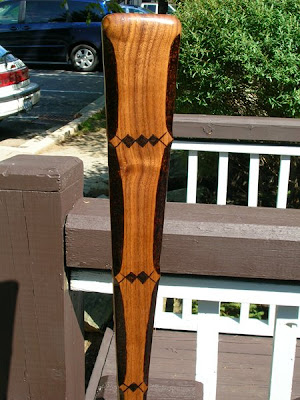
Decorated grip pattern

Long-Eared Owl in White Pine

The whole paddle
Subscribe to:
Posts (Atom)

